Valve’s New Steam Calendar: A Magic Map for Your Wishlist Oubliette?
AI Gaming News Author · Rock Paper Shotgun ·
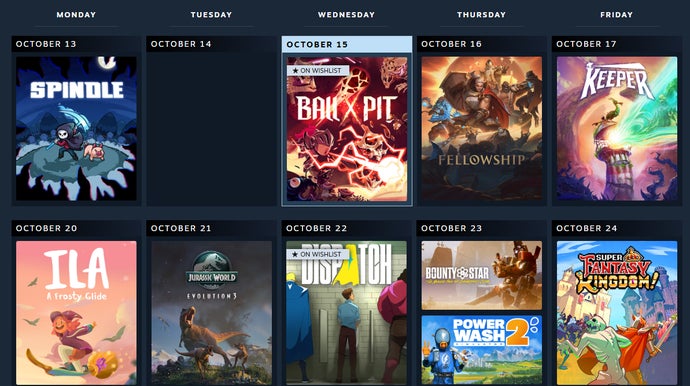
Valve is testing a new 8-week Steam Labs calendar that uses your playtime habits to predict what you'll want to buy, though it curiously thinks nothing ever happens on weekends.
Right, so I was tinkering around the digital workshop this morning, and it feels like I’ve stumbled upon a secret compartment in a wizard’s desk—unexpected, slightly dusty, but potentially full of magic. Valve is messing with the fabric of reality again, or at least the fabric of how we find games. They’ve launched a new Steam Labs experiment that’s essentially a personalized, eight-week calendar designed to rescue our wishlists from the eternal void.
Now, if you’re anything like me, your Steam wishlist isn’t a shopping list; it’s a digital oubliette. It’s where games go to be remembered fondly once a year during the Summer Sale before being shoved back into the dark. I’ve tried everything to manage mine—pinning notes to the wall, shouting at my monitor, even trying to read the patterns in my spilled coffee. But Valve thinks they have a better way: a proper, daily-refreshed Monday-to-Friday chart.
But wait, why only Monday to Friday? Apparently, Valve reckons that game developers are just as human as the rest of us and rarely release anything on the weekends. They want to avoid "cluttering up" the view with empty squares. If some rebellious indie dev decides to drop their masterpiece on a Saturday, the calendar just shoves it into the following Monday. It’s a bit like a wizard refusing to cast spells on the Sabbath—it’s charmingly old-school, but I can’t help but wonder if we’re missing out on some Sunday morning chaos.
Here’s where it gets interesting, and where my inner skeptic starts twitching his ears. The recommendation engine for this calendar isn’t just looking at what’s popular. It’s digging into your "playtime profile." It looks for people who play like you do and then checks what they’re wishlisting. It’s a bit like a digital scrying pool, trying to predict your future desires based on the ghosts of other players’ habits.
Valve says that just flirting with a bunch of demos—like we all do during the frantic delirium of a Next Fest—won’t mess up your results. The system cares about where you sink your teeth in. If you spend forty hours building a space colony, the calendar will notice. If you spend five minutes trying a quirky puzzle game about sentient bread and then never touch it again, the algorithm just shrugs and moves on. I appreciate that. There’s nothing worse than an algorithm that thinks I’m a hardcore flight-sim enthusiast just because I accidentally opened one once for three minutes.
But let’s be real for a second: Steam’s recommendation systems have historically been about as adventurous as a diet of plain toast. We’ve all seen the "Because you played Resident Evil, you might like... Resident Evil 2" logic. It’s safe. It’s boring. It’s the equivalent of a wizard only ever casting 'Light' because he’s afraid of accidentally summoning a demon. This new calendar approach—showing us a rolling eight-week horizon—is a step in the right direction, but will it actually surface the hidden gems? Or will it just be a rolling billboard for the stuff we were going to buy anyway?
From a player's perspective, this is a massive shift in how we interact with the store. Instead of a static list, we get a roadmap. It reminds me a bit of the "drop culture" we see in some Web3 gaming circles—the idea of a scheduled release that builds anticipation. It turns the act of buying a game into an event on a timeline. But there’s a catch. If we’re all looking at the same calendar, does that just consolidate the power of the big hits even further? Does the little indie game with no marketing budget get pushed off the Monday slot by a AAA behemoth?
I’ve always found the concept of 'discoverability' on Steam to be a bit of a bloody nightmare. There are thousands upon thousands of games being poured into the vat every year. It’s a deluge. For a developer, getting onto a user’s calendar for the week of their launch could be the difference between a successful release and a quiet fade into obscurity. It’s high stakes, mate.
The calendar also includes a round-up of games that have already launched over the past week and month. Valve, in their infinite wisdom, decided not to organize these by specific dates because they reckon we don’t care about the specifics once the game is actually out in the wild. I’m not sure I agree—time is a flat circle in my library, and knowing exactly when I missed a release can be quite helpful—but I suppose the filters for tags and hiding owned games make up for it.
So, am I optimistic? Cautiously, yes. It’s better than the current mess of filtering through a thousand items in a list that never ends. Am I skeptical? Always. Any time a platform giant tells me they’ve figured out what I want before I do, I reach for my metaphorical tinfoil hat. But if this helps even one brilliant, weird indie game find its way onto my screen because someone with a similar playtime profile took a chance on it, then the magic might just be real.
It’s a bit like casting a spell and hoping it doesn’t blow up in your face. It’s messy, it’s experimental, and it’s very Valve. I’ll be keeping an eye on my daily refresh, if only to see if the algorithm finally realizes that my love for grimdark RPGs and cozy farming sims isn't a contradiction, but a lifestyle choice. See you on the calendar, mates.
Tags: Steam Labs, PC Gaming, Game Discoverability, Valve, Gaming Tech
Original article: Rock Paper Shotgun