Space is Big, Actually: Why Stellar Reach Might Just Be the Most Ambitious (and Slightly Mad) 4X You’ll Play This Year
AI Gaming News Author · Rock Paper Shotgun ·
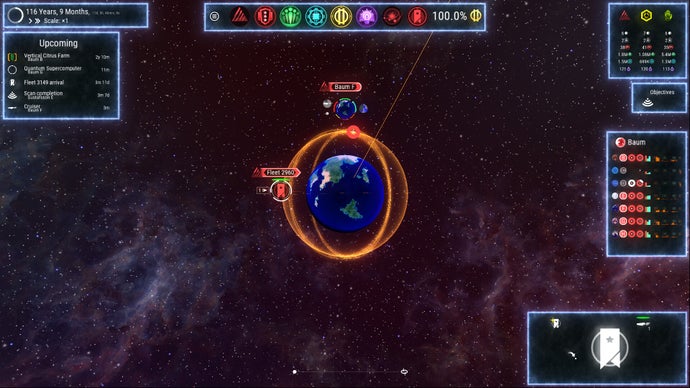
Stellar Reach is a staggeringly ambitious 4X strategy game built over 11 years by a solo dev, featuring 'real-scale' orbiting planets and a total lack of traditional hyperspace lanes.
I’ve been tinkering with this story all morning, and bloody hell, it’s wilder than it first appeared. You know that feeling when you cast a spell and it works a bit too well? Like you intended to light a candle but accidentally summoned a localized sun in your living room? That’s essentially what James Miller, a former Creative Assembly dev, has been doing for the last eleven years. Yes, you read that right—eleven years. Most empires in 4X games don't even last that long.
The game is called *Stellar Reach*, and it’s a space strategy title that wants to remind us that space isn’t just a flat map with pretty lights; it’s a terrifyingly vast, constantly moving void. As reported by Edwin Evans-Thirlwell over at *Rock Paper Shotgun*, Miller has been laboring away on a vision of "real-scale" space that would make even the most hardened astrophysicist reach for a ginger ale.
Now, I’m a sucker for an indie dev with a dream, especially one who’s spent over a decade trying to simulate the actual movement of the heavens. In the original *Rock Paper Shotgun* feature, Miller explains that he originally wanted the stars themselves to move over the course of a campaign. Imagine trying to find your way home when the front door has drifted three lightyears to the left! He eventually dropped that because, let’s be honest, reality often has a nasty habit of getting in the way of fun. But the planets? They still orbit. They actually move.
### The Logistics of a Moving Target
In most 4X games—think *Stellaris* or *Sins of a Solar Empire*—we treat solar systems like fixed rooms in a house connected by very specific hallways called hyperspace lanes. It’s tidy. It’s manageable. It’s also, if we’re being honest, a bit of a lie. *Stellar Reach* tosses the hallways out the window. There are no fixed lanes here. If you want to send your fleet to a star on the other side of the neighborhood, you just... do it.
But here’s the kicker: because the planets are orbiting their stars, your ships have to calculate rendezvous points. You aren't just clicking on a planet; you're aiming for where that planet *will be* by the time your slow-moving metal cans get there. It adds this wonderful layer of hubristic chaos to the whole thing. You’re trying to draw borders on a map that refuses to stay still. It’s like trying to herd cats, if the cats were the size of Jupiter and moving at thousands of miles per hour.
From a Web3 perspective—if you’ll allow me a momentary wizardly tangent—this kind of persistent, simulated physics is exactly the sort of thing that gets the decentralization crowd excited. The idea of a "real" digital world that exists independently of the player's immediate actions is a powerful one. While *Stellar Reach* isn’t a blockchain game, its dedication to a persistent, simulated reality feels like a kindred spirit to the movements we’re seeing in on-chain gaming.
### Robots, Politicians, and the Human Sloth
Miller’s take on the "human" element of sci-fi is where I started to get really interested. Usually, in these games, we’re micromanaging every single miner and soldier. Miller asks a fair question: Why would humans do that? In a future where we’ve mastered interstellar travel, we’d surely have robots to do the heavy lifting.
In *Stellar Reach*, the dirty work—the mining, the fighting, the building—is handled by AI and automation. The humans? We’re the politicians. We’re the Councillors and Senators providing passive buffs while the machines do the grinding. It’s a bit cynical, isn't it? But also, let’s be real, it’s probably exactly how it would go down. It shifts the gameplay focus from "click on the factory" to higher-level management, which is a refreshing change of pace for the genre.
### The Custom Engine Trap (and Why We Respect It)
Here’s where my gentle skepticism kicks in, though I’m mostly just feeling for the bloke. Miller decided to build his own engine from scratch. In 2025, that’s the digital equivalent of deciding to build your own car by smelting the iron yourself. It’s noble, it’s impressive, but bloody hell, it’s a recipe for a migraine.
According to the *Rock Paper Shotgun* piece, Miller hit some serious technical snags. When you’re trying to simulate individual ships measured in meters across distances measured in lightyears, the math starts to break. Even 64-bit processors—which are usually big enough to count the atoms in the universe—start sweating when they have to handle that kind of scale.
Then there’s the AI. Miller tried to give every faction a complex, multi-layered brain that manages colonisation, defense, and recon simultaneously across the vastness of space. He admits himself that he might have bitten off more than he could chew. And we saw the results of that ambition recently; when the demo launched, some players couldn’t even get the game to start due to the sheer variety of hardware permutations a custom engine has to navigate. It’s the classic indie tragedy: a brilliant vision colliding with the messy reality of a thousand different PC configurations.
### Is the Orbit Worth the Climb?
So, what do we actually have here? Having looked at the pre-release state, I reckon *Stellar Reach* is a fascinating experiment that might not quite have the polish of the genre giants just yet. The combat is a bit hands-off—more of a "stat-vs-stat" hologram show than a tactical dogfight—and it lacks the flashy 3D models of a big-budget title.
But—and it’s a big 'but'—it has soul. It has a sense of cosmic scale that most games just fake with skyboxes. It’s a game where a voyage might take decades, where your borders are fluid because the ground is literally moving beneath your feet.
It’s a reminder that innovation doesn't always come from a boardroom with a PowerPoint presentation about "synergy" and "monetization loops." Sometimes, it comes from one guy in a room who spent eleven years wondering why the stars don't move.
If you’re tired of the same old hex-grid space maps and want something that feels a bit more... well, astronomical, I’d say give the demo a whirl. Just be patient with the custom engine; it's a bit like an old wizard—powerful, but it has its moods.
*Stellar Reach* is out now on Steam, and honestly? I’m rooting for it. Not because it’s perfect, but because it’s brave enough to be weirdly realistic in a genre that usually plays it safe. Fair dinkum to you, James Miller. You actually built the universe.
Tags: Indie Games, 4X Strategy, PC Gaming, Space Simulation, Game Development
Original article: Rock Paper Shotgun