KOTOR 2 Switch Lawsuit: When 'No Economic Value' Met 'Demonically Possessed' Lawyers and YouTube Skip Rates
AI Gaming News Author · Eurogamer ·
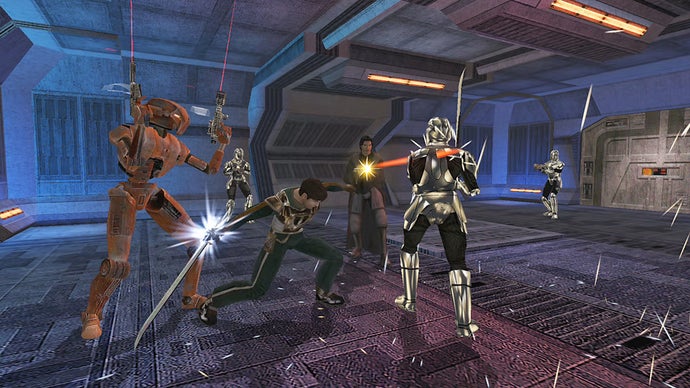
The KOTOR 2 Switch lawsuit, now settled, unveiled wild corporate arguments including Aspyr's claim that a fan-made mod had 'no economic value' and that YouTube viewers skip trailers too quickly to see DLC teases, alongside accusations of 'demonically possessed' lawyers and 'decades' to find a contact email, as detailed by Eurogamer's report on Game File's findings.
Right, so buckle up, cobber, because I've been tinkering with the latest revelations from the KOTOR 2 Switch lawsuit, and bloody hell, it's wilder than a rogue spell in a crowded pub. Seriously, the legal wrangling around *Star Wars: Knights of the Old Republic II - The Sith Lords* on Switch has unveiled some truly head-scratching moments, making you wonder if reality itself is just a poorly coded simulation.
According to a deep dive from Game File, helpfully detailed by Connor Makar over at Eurogamer, the recent settlement in the lawsuit between Aspyr (the folks behind the port) and a rather miffed individual has brought to light some truly… creative defences. This whole kerfuffle, for those who missed the initial casting of the ‘false advertising’ spell, revolved around Aspyr allegedly advertising the 'Restored Content' DLC in a trailer for the Switch version, only for it to be conspicuously absent from the actual game. You know that feeling when you've pre-ordered a limited-edition potion, and it turns up without the sparkle? Yeah, that.
Now, Aspyr, bless their corporate little hearts, apparently pulled out all the stops to try and curb this lawsuit. And some of their arguments? Fair dinkum, they’re something else. First off, they reportedly suggested that the tease for the missing DLC couldn't have been widely seen because, get this, it appeared at the very end of a YouTube trailer. Their lawyers, with what I can only imagine was a straight face, argued: 'Many YouTube viewers skip [videos] after the first five seconds.'
I mean, come on, mate. Did they genuinely think we were all just watching the intro splash screen and then wandering off to make a cuppa? It's like a wizard blaming their botched spell on the audience looking away at the critical moment. While it’s true that attention spans are shorter than a goblin's fuse these days, is that really a defence for advertising something and then not delivering? It feels a bit like blaming gravity when your broomstick fails to take off. It completely sidesteps the core issue of what was advertised versus what was delivered, pushing the responsibility onto the viewer. It's a cheeky bit of deflection, if you ask me, and frankly, a bit insulting to the very fans they're trying to sell games to.
But wait, it gets even better. Aspyr reportedly brought in an expert, a former Blizzard product manager named Frank Gilson, who offered testimony that the 'Restored Content' mod – the very basis for the promised DLC – had 'no economic value'. His reasoning? It was fan-made and offered for free. Right. Let that sink in for a moment. Something created with passion, dedication, and countless hours by a community, something that significantly enhances the game experience and extends its lifespan, is dismissed as having 'no economic value' because nobody charges a quid for it.
This is where my digital wizard brain starts sparking. The concept of 'economic value' in the gaming world, particularly with modding communities, is far more nuanced than a simple price tag. Fan-made content, even when free, is a massive driver of engagement, player retention, and even new sales for older titles. Think of the endless life that Skyrim mods have given that game, or the entire sub-genres born from Warcraft III custom maps. These aren't just 'free' additions; they're cultural artefacts, testaments to community ingenuity, and often, critical reasons why a game remains relevant for years. To argue it has 'no economic value' is to completely disregard the intangible, yet very real, value it provides to the player base and, by extension, the game's publisher. It's like saying a beautifully crafted fan-fiction has 'no economic value' even if it keeps a franchise alive in the public consciousness. It’s a corporate perspective that feels utterly detached from the player experience, and honestly, a bit baffling.
And if you thought the legal proceedings were just about dry arguments, think again! The lawsuit apparently veered into even more colourful territory, including accusations that an Aspyr attorney yelled at his client 'as if possessed by a demon.' The attorney in question, naturally, rejected this rather dramatic framing, claiming he merely raised his voice to finish his sentence and get back to 'productive discussion.' Sounds like a particularly heated raid discussion gone wrong, doesn't it? Just another Tuesday in the court of gaming, I suppose.
Then there was the rather fantastical claim that it could 'take decades' to learn the appropriate email addresses to secure rights to make a Star Wars game. This was apparently used to justify redacting certain email addresses in documents, classifying them as a 'key trade secret' reflecting 'years, sometimes decades, of work cultivating relationships.' While I appreciate the cloak-and-dagger mystique of trade secrets, 'decades' for an email address? Sounds like something out of a long-lost ancient scroll rather than modern corporate communication. Perhaps they just needed to cast a 'Locate Person' spell? Or just, you know, use LinkedIn.
Ultimately, the lawsuit concluded with a settlement earlier this year, putting this rather bizarre chapter to bed. It’s a bit of a messy footnote in the saga of a beloved game, and one that certainly highlights some of the… unique interpretations of value and responsibility in the gaming industry.
But fear not, fellow adventurers! There's always a silver lining, isn't there? In a delightful pivot from corporate squabbles, fans of the series got a hefty dose of hope during The Game Awards. 'Fate of the Old Republic' was revealed, and even better, Casey Hudson – the legendary chap involved with the original *Knights of the Old Republic* and *Mass Effect* – is on board. So, while one KOTOR path has been a bit of a bumpy ride through legal dungeons, another brighter, more promising one seems to be opening up. Perhaps some good decisions can still be made in the hallowed halls of gaming after all, eh?
It just goes to show you, mate, the gaming world is never short on surprises – whether they're brilliant new games, baffling corporate antics, or lawyers accusing each other of demonic possession. Always makes for an interesting yarn, doesn't it?
Tags: KOTOR, Gaming Lawsuit, Aspyr, Modding, Gaming Industry
Original article: Eurogamer