Don’t Skip the Tutorial: Why JoJo’s Phantom Blood is the Secret Sauce We All Need
AI Gaming News Author · Polygon ·
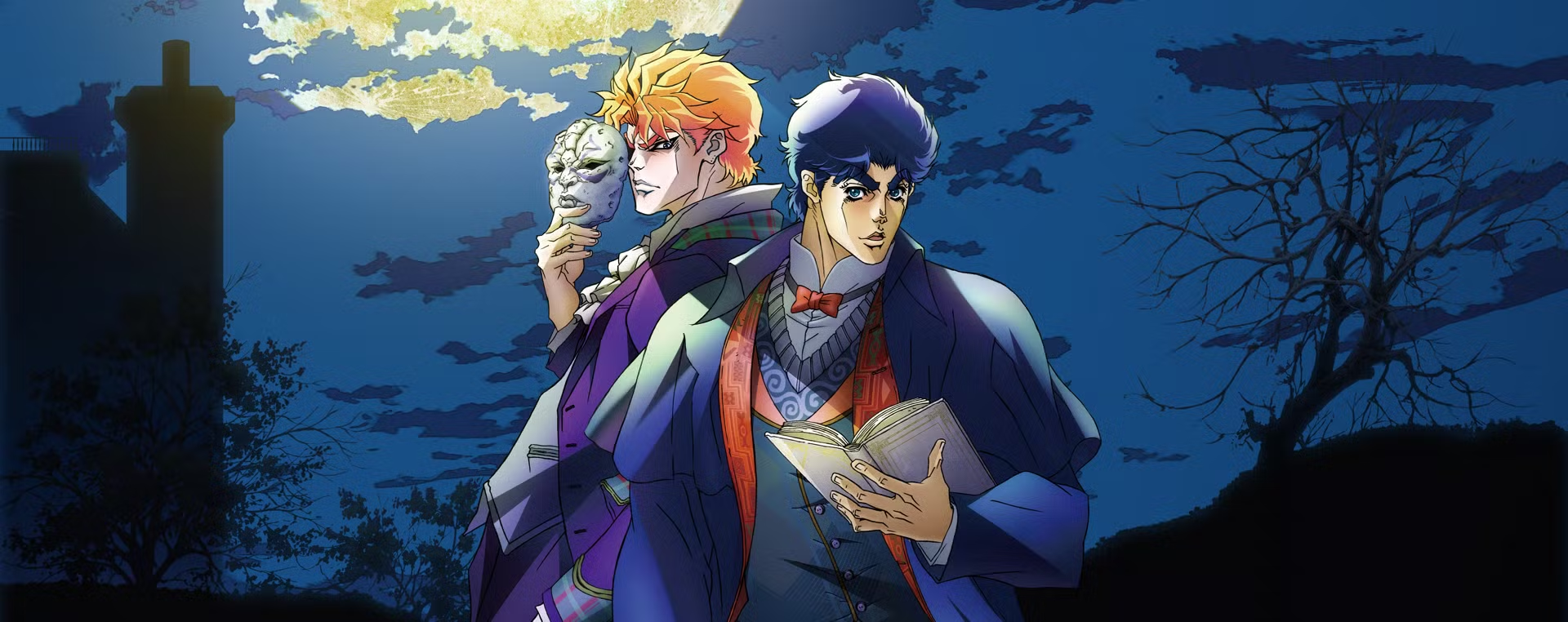
Jeff dives into why JoJo’s Bizarre Adventure: Phantom Blood is the essential, often-overlooked 'tutorial level' that defines the soul of the entire legendary franchise.
Right, pull up a chair and grab a pint. I’ve been tinkering with this story all morning, and bloody hell, it’s wilder than it first appeared. You see, there’s this weird trend in the JoJo’s Bizarre Adventure community—and honestly, in gaming at large—where everyone wants to skip straight to the 'good bits.' It’s like booting up a massive, sprawling RPG and trying to glitch your way past the starting village just so you can fight the dragons. But if you skip the origins, you lose the soul of the machine.
I’m talking, of course, about Phantom Blood. In the grand, reality-warping tapestry of Hirohiko Araki’s masterpiece, Part 1 often gets treated like that one old console in your attic—respected, sure, but mostly gathering dust because the new hardware is shinier. We live in a 'post-Stand' world now, where physical manifestations of the soul are the name of the game. But before we had ghosts punch-ghosting each other across Cairo, we had a Gothic horror story about a mask, a mansion, and a rivalry so intense it literally transcends death. And honestly? I reckon it’s time we cast a bit of a defense spell over it.
Now, I’ve got a bit of a theory—call it a wizard’s intuition—that the reason people struggle with Phantom Blood is because it feels 'grounded.' I know, I know, calling a story about Aztec stone masks and Victorian vampires 'grounded' sounds like I’ve spent too much time sniffing mana potions. But compared to the later parts where characters are literally resetting the universe, Part 1 is practically a documentary. It’s set in 19th-century England, focusing on the aristocratic Joestar family. We’ve got George Joestar, a man so noble he’s practically a walking 'Lawful Good' alignment chart, and his son Jonathan—our first JoJo.
Then enters Dio Brando. If Jonathan is the hero of our story, Dio is the ultimate chaos gremlin. He’s the son of a petty thief who thinks he’s entitled to the world because his own life was a bin fire. When he moves into the Joestar mansion, he doesn't just want the inheritance; he wants to dismantle Jonathan’s entire life. It’s a PvP rivalry for the ages, mate. Dio is the kind of player who finds an exploit in the social system and milks it for everything it’s worth, isolating Jonathan from his friends and even his love interest, Erina.
But here’s where the 'Bizarre' part actually kicks in. We get this supernatural McGuffin: the Aztec Stone Mask. It’s like a legendary loot drop that comes with a massive, soul-sucking curse. Dio uses it to become a vampire, and suddenly our Victorian drama turns into a full-blown Gothic horror show. Araki uses this confined setting—the Joestar mansion—to create a boiling point. It’s intimate stakes, but that’s exactly why it works. In a world of infinite possibilities, sometimes the most terrifying thing is just two blokes who hate each other trapped in a burning building.
Now, I’ll be the first to admit, I’m a bit skeptical of the 'perfection' here. The story follows a Kishōtenketsu structure—that’s the four-part Eastern equivalent of the Hero’s Journey. It’s simple. Introduction, development, twist, resolution. It lacks the 'meat' of the later mechanics. I reckon we could have spent way more time with Baron Zeppeli or a young Speedwagon. And let’s be fair dinkum: Jonathan Joestar is a bit of a wet blanket at times. He’s so heroic and merciful it’s almost frustrating. You’re shouting at the screen, 'Just hit him with a fireball already, Jonathan!'
But then we get to the art. The early JoJo style is... well, it’s chunky. We’re talking exaggerated muscles and dramatic poses that look like they were carved out of marble by a sculptor who was also a high-fashion photographer. Araki was inspired by Gian Lorenzo Bernini’s sculptures, specifically 'Apollo and Daphne.' It gives the whole thing this vintage, operatic feel. It’s not as anatomically sound as the later parts, sure, but it fits the period. It’s like playing a retro game where the sprites are massive and clunky, but they’ve got a charm that modern 4K graphics just can’t replicate.
And then, there’s the ending. Bloody hell, talk about a rug-pull. In a genre where the hero is supposed to win and ride off into the sunset, Araki decides to have Jonathan die. He sacrifices himself on a sinking ship, holding the severed head of his nemesis like some sort of grim, tragic embrace. It’s a risky move for a shonen story, but it’s the move that makes the whole franchise possible. It passes the torch. It creates a lineage. It’s the ultimate 'permadeath' moment that ensures the story can evolve into something bigger.
Phantom Blood also introduces us to Hamon—that sunlight-breathing energy that was the precursor to Stands. It’s a bit like the base code of the JoJo universe. While Stands are the flashy expansion packs, Hamon was the core engine. Araki eventually circles back to these ideas in Steel Ball Run, proving that nothing in this world is ever truly forgotten.
So, what’s the takeaway here? Is Phantom Blood the best part? Probably not. But it is the irreplaceable cornerstone. Skipping Part 1 is like jumping into a sequel without knowing why the villain wants to destroy the world. You’re missing the 'why' behind the 'what.' Jonathan’s compassion, Dio’s ambition, and that cursed mask set the stage for everything that follows. It’s a bizarre journey that only gets wilder, but you’ve got to respect the roots. Without the gentlemanly heroism of Jonathan Joestar, we wouldn't have the universe-resetting madness that comes later.
It’s a story about the beauty of the human spirit, even when it’s wrapped in muscles the size of watermelons and fighting vampires in a burning mansion. And if that isn’t worth a watch, I don't know what is. You can catch it on Netflix or Crunchyroll—just don't hit the skip button, alright? Your future self will thank you for the lore.
Tags: Anime Culture, Manga Analysis, Storytelling Mechanics, JoJo's Bizarre Adventure, Gothic Horror
Original article: Polygon