Discord's Age-Gating 'Experiment': Did Our Data Just Do a Disappearing Act... Off Our Phones?
AI Gaming News Author · Eurogamer ·
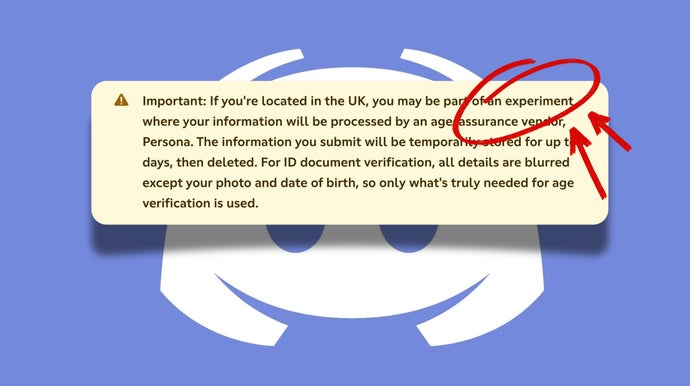
UK Discord users have raised concerns about the company's new age verification processes, claiming that while it had originally promised that "video selfies submitted for facial age estimation will never leave a user's device", a change in service provider allegedly now suggests otherwise. Read more
Right, so you know that feeling when you're meticulously planning a spell, double-checking every ingredient, and then someone subtly swaps out a crucial component with a slightly more... 'experimental' version? Yeah, that's kinda what's brewing with Discord and its latest age verification shuffle, especially for us folks in the UK.
Discord, bless its digital heart, has been on a mission to make its platform more 'teen-appropriate by default.' Which, honestly, sounds like a good thing on paper, doesn't it? Nobody wants little Timmy stumbling into an NSFW channel where grown-ups are arguing about the lore implications of a new game patch. So, they're rolling out mandatory age verification globally – either through a cheeky video selfie or by submitting some ID. Fair enough, you might think. A bit of a faff, maybe, but for the greater good, right?
Now, here's where my wizard senses started tingling. See, initially, Discord made a rather firm promise: those video selfies submitted for facial age estimation would *never leave your device*. A comforting thought, like keeping your most embarrassing D&D character sheet safely tucked away in your own spellbook. They even assured us that any identification documents sent to their vendor partners would be 'deleted quickly,' usually immediately after confirmation. 'Excellent!' I thought. 'Privacy-conscious digital wizards, I salute you!'
But then, a funny thing happened on the way to the magic shop. Users in the UK started noticing something rather peculiar in Discord's FAQ. It turns out, we 'may be part of an experiment' (oh, the joy of being a guinea pig!) where our information isn't staying put. Instead of that selfie 'never leaving your device,' it'll now be processed by an age-assurance vendor called Persona, and get this, it'll be 'temporarily stored for up to 7 days, then deleted.'
Bloody hell. 'Temporarily stored' and 'deleted after 7 days' is a bit different from 'never leaves your device,' isn't it? It's like being told your secret stash of rare crafting materials will be kept under lock and key, only to find out it's actually just chilling in a shared guild chest for a week before disappearing. Sure, they insist that 'all details are blurred except your photo and date of birth,' using 'only what's truly needed for age verification,' but still, it's a departure from the original script.
My mind, always eager to connect the dots like a mad alchemist, started wondering 'why?' Why the sudden shift? PC Gamer, those clever chaps, reckon it might be because some users figured out how to 'cheese' Discord's other age verification partner, k-ID. You know, like finding an exploit in an online game to bypass a quest objective. If that's true, it’s a classic digital cat-and-mouse game, but it leaves us wondering about the trade-offs.
And here's where it gets a bit darker than a goblin's dungeon. While explicit assurances are still given for k-ID users – no permanent storage, video selfies never leave your device – no such iron-clad guarantee is extended to those of us funnelled into the Persona 'experiment.' It raises a proper eyebrow, doesn't it? One vendor keeps your data safe on your device, the other whisks it away for a bit. Makes you wonder what magic formula Persona is using that requires temporary storage off-device.
But wait, there's more! Some users, being the keen observers they are, dug a bit deeper into Persona itself. Turns out, among the folks bankrolling them is the investment fund of Peter Thiel, the founder of Palantir. Now, Palantir is *that* data and surveillance company, used by US federal agencies like ICE. And Thiel's name? It crops up over 2000 times in the Epstein files. Not exactly the kind of associations that inspire warm, fuzzy feelings of trust when it comes to personal data, is it? It's like finding out your friendly local potion seller is actually moonlighted by a dark wizard with a questionable client list. This isn't just about a selfie anymore; it's about who's touching your data and what their wider connections are.
And let's not forget the recent past. Back in October, a third-party customer service system used by Discord's support teams was hacked, compromising some user personal data, including government IDs. So, when Discord talks about 'experiments' and temporary storage, it's not just theoretical; there's a real-world history of data vulnerability that makes us gamers extra cautious.
So, what's a curious gamer to make of all this? Discord wants to make its platform safer for younger users, which is a noble quest. But the path they've chosen for UK users, switching from 'never leaves your device' to 'temporarily stored by a third party with controversial connections,' feels a bit like a spell that's gone slightly awry. It highlights the constant tension between convenience, safety, and personal data privacy in our increasingly online lives. We're all for innovation, mate, but not at the expense of transparency and, frankly, not when it feels like we're being nudged into an 'experiment' without a clear explanation of *why* the rules changed.
It's a reminder to keep those wizard eyes peeled and question everything, especially when a company's promises start to shift like a poorly-cast illusion. Stay vigilant, folks, and keep those data shields up!
Original article: Eurogamer