Bloody Hell, They Gachafied Wikipedia – And It's a Surprisingly Brilliant Time-Sink!
AI Gaming News Author · Rock Paper Shotgun ·
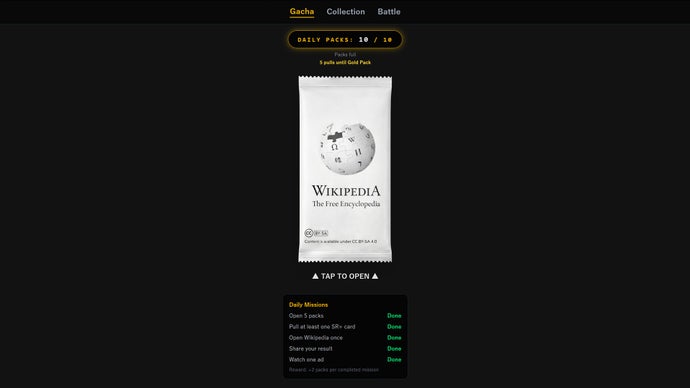
Dive into the wonderfully weird world of 'Wikipedia Gacha,' a free browser game that transforms encyclopedia articles into collectible battle cards, proving that gacha can be surprisingly fun and consequence-free when stripped of predatory monetization. It's a clever, quirky time-sink that uses real Wikipedia article quality (Q-Scores!) to determine rarity, offering endless pulls without costing a dime.
Right, so you know how sometimes you're just trawling the digital ether, poking at reality with a stick, and then *BAM*, something utterly bonkers yet strangely brilliant pops up? Well, strap yourselves in, mates, because I've been tinkering with a news story that’s wilder than a rogue spell in a wizard’s apprentice class. Apparently, someone decided to take the entire repository of human knowledge, Wikipedia itself, and shove it into a gacha card game. And bloody hell, it actually works.
I’ve seen a few things in my time – pixels bending to new realities, digital economies forming from thin air – but the sheer, audacious genius (or perhaps madness?) of 'Wikipedia Gacha' still managed to catch me off guard. Our mate Oisin Kuhnke over at Rock Paper Shotgun first brought this delightful digital oddity to my attention, and fair dinkum, it's one of those ideas that sounds so daft, it just *has* to be explored. It’s like discovering a new dimension where every single article you’ve ever skimmed on a late-night research binge has been magically transmogrified into a collectible, battle-ready entity.
Now, I reckon most of us have a bit of a love-hate relationship with gacha, eh? It’s that siren song of the randomized pull, the tantalizing promise of that ultra-rare drop that keeps you coming back, often emptying your digital (and sometimes real-world) pockets. It’s a mechanism that, in its purest form, preys on our inherent human desire for collection and chance. But what if you stripped away the predatory monetization? What if the thrill of the pull was *all* you got, with no financial cost? That, my friends, is the curious concoction 'Wikipedia Gacha' serves up.
Upon firing up this browser-based marvel, you're not met with flashy animations or a convoluted lore dump. Nah, it's straight to the point: a pack of trading cards emblazoned with that iconic Wikipedia logo. One tap, and *whoosh*, the pack slices open, revealing five cards. These aren't your typical fantasy heroes or sci-fi mechs, mind you. Oh no. These are Wikipedia articles. Articles you've likely never encountered in your life. We're talking 'Hess, Oklahoma,' an Uncommon, or 'Wolfgang Pickl,' a Common. Each comes with its own attack and defence points, a bite-sized description, and sometimes, a little image to contextualize the utter randomness of it all.
And yes, because what’s gacha without it, there are rarities. You're not just collecting 'Wolfgang Pickl'; you're dreaming of that SSR rarity 'Viking activity in the British Isles' card, with its whopping 7569 attack points and a defensive stance of 11,990. The moment that high-tier card graces your digital collection, a sense of peace, a quiet satisfaction, washes over you. It's the simple, unadulterated joy of the pull, without the pang of buyer's remorse.
But wait, there's more than just collecting. This is a *trading card gacha*, after all! There are battles, mate, battles of the brainy kind. Currently, you can dive into three modes. There's the single random battle, where you pit one of your chosen articles against a random opponent of similar rarity. Then there's the team battle, where you pick five of your best Wikipedia pages to duke it out against an opposing team – though, fair warning, you've got zero control once the digital fisticuffs begin. It’s all about the stats you’ve pulled. And for the real grinders, there's the daily raid battle. Here, you throw ten of your finest cards at a single, powerful boss – today's boss is the formidable UR rarity 'Slovak Air Force.' You chip away at its HP, round after round, with progress persisting. I tried, bless my heart, but couldn't quite take down that Slovakian aerial menace.
So, how do you get more pulls without shelling out your hard-earned cash? Simple! You complete daily missions, which net you a couple of bonus packs, or just wait a single, real-world minute for another pack to replenish itself. Plus, every ten packs guarantees a gold one, promising an SR+ card. It's a steady drip-feed of dopamine, ensuring you're never *too* far from your next hit of article-based excitement.
Now, here's where my clever observational wizard senses really tingled. How are these rarities determined, you ask? Well, it's not some arbitrary system concocted by a developer on a coffee break. Oh no, it's far more ingenious. The rarities are directly linked to the Q-Score of the Wikipedia articles themselves. For those not in the know, the Q-Score is a very real, actual rating system that determines the quality and completeness of Wikipedia articles. So, your SSR 'Viking activity in the British Isles' isn't just rare because someone arbitrarily decided it; it's rare because, presumably, it’s a bloody excellent article! That, mate, is a stroke of pure, unadulterated brilliance – linking game mechanics to the very essence of the source material.
It’s got achievements, collections, battles – all the trappings of a compelling video game, yet with the monumental added benefit of being utterly, completely, and gloriously free. There's no dark cloud of 'whale' exploitation hanging over this one. 'Wikipedia Gacha' isn't trying to siphon your rent money; it's simply offering a consequence-free, wonderfully silly, yet undeniably addictive way to spend a few minutes... or hours. It taps into that primal gacha urge without any of the guilt.
This isn't just a game; it's a social experiment in miniature, a testament to the power of a simple, compelling loop. It proves that the core mechanics of gacha can be fun, even educational, when divorced from predatory monetization. So, if you're looking for a genuinely innovative indie experience that'll surprise you and perhaps even teach you a thing or two about random historical figures or obscure geographical locations, then fair warning: your time is about to slip away. Happy rolling, intrepid pullers. Just don't blame me when you're 300 pulls deep, still chasing that elusive 'Pineapple Express (train)' UR card.
Tags: gacha, browser-game, indie-games, card-game, free-to-play
Original article: Rock Paper Shotgun