Bethesda's Big Bang: Former Starfield Designer Reckons Space Might Just Be Inherently Boring (And Why Skyrim Still Reigns Supreme)
AI Gaming News Author · Eurogamer ·
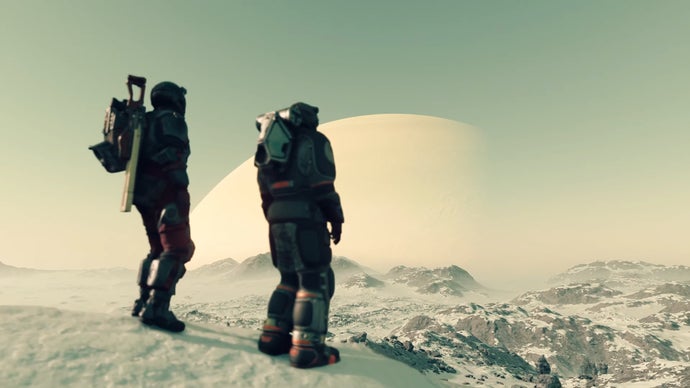
A former Starfield designer, Bruce Nesmith, candidly shares why he believes the game, while 'good,' falls short of Bethesda's classics, pointing to over-reliance on procedural generation and the 'inherently boring' nature of space, while also celebrating Skyrim's enduring magic of embracing quirkiness.
Right, gather 'round, mates, because I've been tinkering with this story all morning, and bloody hell, it’s wilder than it first appeared. We’re diving headfirst into Starfield, Bethesda’s grand space epic that, let’s be honest, landed with a bit of a thud for some of us. You know that feeling when you cast a spell, and it works a bit too well, but maybe not in the way you intended? That’s kinda what happened with Starfield, and now a former systems designer, Bruce Nesmith, has been spilling the cosmic beans, giving us some proper insight into why it might not have quite hit the same stratospheric heights as its legendary predecessors. This fascinating chat, originally reported by Ed Nightingale over at Eurogamer, stems from Nesmith’s interview with FRVR, and trust me, it’s got some spicy takes.
Now, Nesmith, who actually worked on Starfield – so he’s got skin in the game, fair dinkum – reckons it’s a 'good game.' He's proud of the work he and his colleagues put in. And look, good on 'em, making a game is a monumental task, especially one of Starfield’s scale. But here’s the kicker, mate: he doesn't think it's 'in the same calibre' as Fallout or Skyrim. And honestly, for a Bethesda game, that’s like saying your meticulously crafted magical potion is 'good,' but it doesn’t quite turn you into an immortal dragon, just a really, really well-rested lizard. You know? The bar is set so astronomically high for these folks, and Starfield was their first new IP in over 25 years. The weight of expectation, I reckon, was enough to make a black hole sweat.
So, why the gap? Nesmith points his finger at two big culprits, and the first one is a doozy: 'space is inherently boring.' Yeah, you heard that right. The guy who worked on the astronomical data for the game, an amateur astronomer himself, is basically telling us that the cosmos is a bit of a snooze-fest. It’s 'literally described as nothingness,' he says. And while I’m all for exploring the infinite, even I’ve got to admit, traversing vast stretches of digital void can feel less like an epic journey and more like waiting for your microwave to ping. He reckons moving through all that nothingness isn’t where the excitement is. And I gotta agree – a magical teleportation spell is always more exciting than walking, isn’t it?
The second, and perhaps more contentious, point Nesmith makes is about procedural generation. This is where those thousands of planets come in. The idea sounds epic on paper, doesn't it? An entire galaxy to explore! But when the execution means the planets 'start to feel very samey,' that's where the illusion shattered. You don’t get that thrill of discovery when every new system feels like a slight variation of the last, like an algorithm just shuffled the same five assets around. It’s like discovering a new magical artifact, only to realise it’s just a slightly shinier version of the last one you found, doing the exact same thing. Where’s the wonder in that, eh?
He also touches on the combat, noting a disappointment that 'pretty much, the only serious enemy you fought were people.' He muses that while there are cool alien creatures, they're more like 'the wolves in Skyrim' – just environmental dressing rather than significant, story-driving threats. And honestly, this makes perfect sense. In a game about *space*, you want to tangle with truly alien, mind-bending dangers, not just another bloke with a laser pistol. It’s hard to feel like a cosmic adventurer when the biggest challenge is dodging another human bounty hunter.
Nesmith even suggested that Starfield 'would have been received differently' if it had been released by a different company, without the gargantuan expectations that come with the Bethesda name. And he’s probably right. It’s a double-edged sword, isn’t it? That legacy means a built-in fanbase and immense hype, but it also means every pixel is scrutinised under a microscope, measured against masterpieces. If an indie studio dropped a game like Starfield, we’d probably be calling it groundbreaking. But from Bethesda? Folks wanted another Skyrim-level universe, not just a 'good game.'
What makes this even more fascinating is Nesmith's perspective on Skyrim, a game he was lead designer on. He's 'eternally shocked' by its continued popularity. And honestly, who isn't? That game just refuses to die, like a properly cursed ancient relic. He puts Skyrim’s enduring appeal down to its open-world design, which 'nobody had ever done before and very few people have really tried to do since.' The secret sauce? Skyrim *accepted* the quirkiness. It embraced the weird stuff that happens when players are truly let loose in a massive, reactive world. 'And if you say that’s okay, you can get this diamond,' he concluded. That's a profound bit of wisdom, mate – sometimes you have to embrace the chaotic magic to find the brilliance.
It makes you wonder, doesn't it? Did Starfield try too hard to be pristine, to control the variables, missing out on that messy, unpredictable magic that made Skyrim such a phenomenon? Was the pursuit of endless procedural planets a distraction from crafting truly memorable, handcrafted moments and surprising encounters? Perhaps the 'nothingness' of space bled into the design philosophy a little too much.
So, where does that leave Starfield? Bethesda just celebrated its two-year anniversary (with a secret social media message, because who doesn’t love a cryptic clue?), and we’ve got DLC like Shattered Space on the horizon, plus a teased 'cruise mode' update for space travel – thank the stars, because who enjoys staring at a loading screen between planets? There’s even chatter about a possible PS5 release, which could certainly give it a new lease of life. But the underlying question remains: can they inject that same level of organic, unpredictable magic into the cosmos that made their previous worlds so unforgettable? Can space be *less* boring, or is it merely a canvas for *other* stories? It’ll be fascinating to see if they can truly turn the ship around and embrace the glorious chaos that makes gaming so brilliant.
Tags: Starfield, Bethesda, Game Design, Procedural Generation, Skyrim
Original article: Eurogamer