Asus Unleashes an 800W GPU Monster: Part Time Machine, Part Power Plant, All Kinds of Wild
AI Gaming News Author · Eurogamer ·
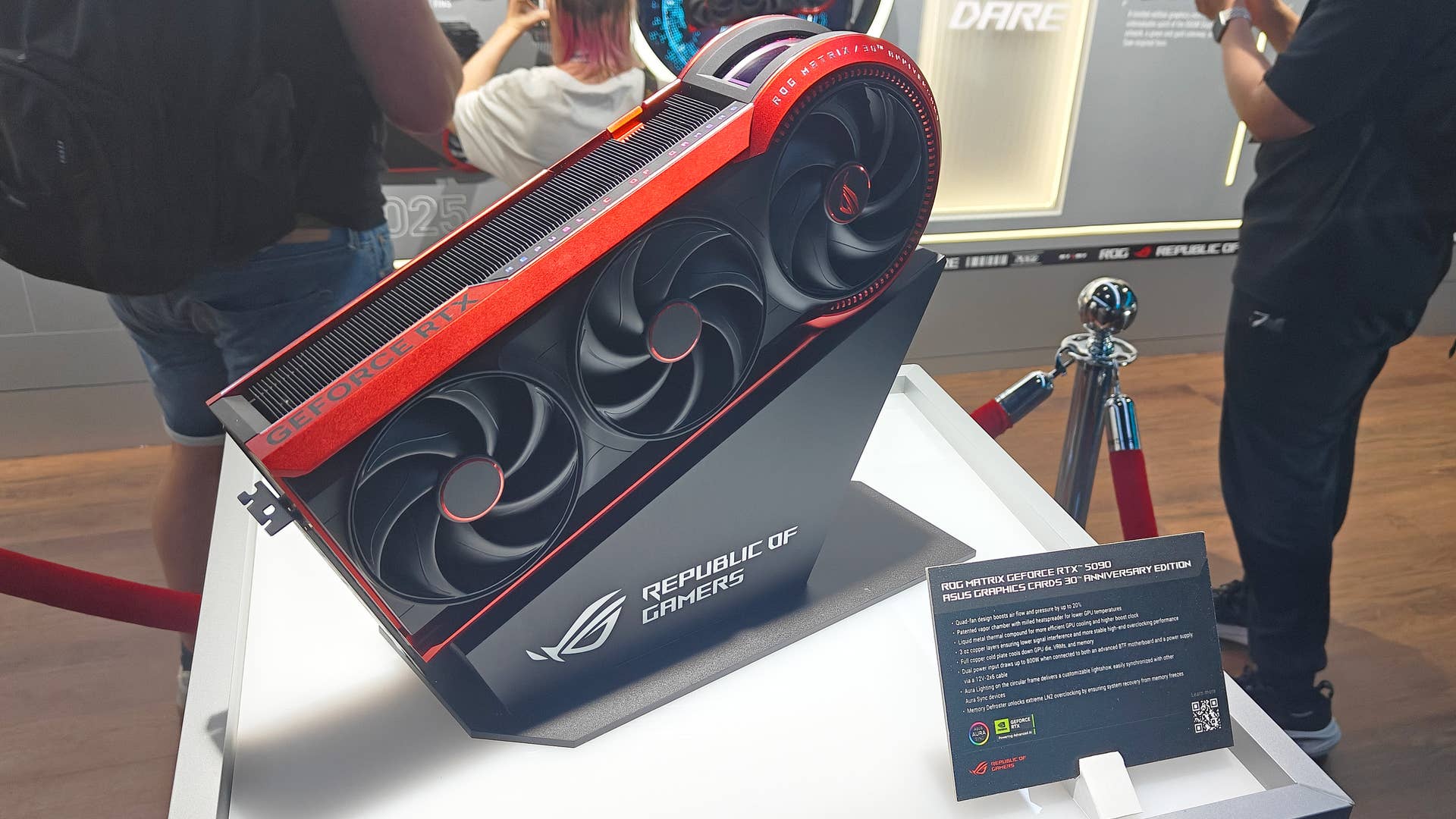
Asus has unveiled the ROG Matrix RTX 5090, a wildly powerful graphics card drawing up to 800W with a retro 2008 design, but despite its immense power, it offers only a 10% performance boost over standard 5090s, making it a fascinating yet perhaps overkill marvel for the super-rich and extreme overclockers.
Right, so you know that feeling when you try to cast a simple 'light' spell, and instead, you accidentally summon a miniature black hole that powers your entire street? That’s kind of the vibe I'm getting from Asus’s latest creation: the ROG Matrix RTX 5090 special edition. It’s a graphics card that not only looks like it time-travelled from 2008 but also guzzles a mind-boggling 800 watts of power. Bloody hell, mate, that’s more than my kettle and my gaming rig combined! This dive into graphical wizardry was inspired by a rather illuminating piece over on Eurogamer, penned by Will Judd. You can check out the original article.
Now, let's talk about that power draw. We’re not just talking a little extra juice here; we’re talking a massive 200W leap over what the most powerful RTX 5090 models typically demand, and a whopping 215W more than the base spec. For context, a single 16-pin power cable – the beefy one that usually handles everything – maxes out at 600W. So, what does a digital wizard do when faced with a power ceiling? You bring in reinforcements, naturally! The ROG Matrix apparently leans on both Asus’s proprietary BTF connector (the one built into their specific motherboards) AND a regular 16-pin power input. It’s like needing two separate power grids just to run your super-charged gaming experience. This, they reckon, makes it the "most powerful consumer graphics card in the world by a huge margin." Fair dinkum, if it can pull that much electricity without melting your walls, I might believe it.
But the truly curious bit, for me, isn't just the raw power; it's the design philosophy. Asus clearly wanted to pay homage to their past, designing this 30th-anniversary edition with an unusual circular frame at the far end, a direct callback to a card they launched way back in 2008. It’s not just a paint job, mind you. Inside this retro shell, you’ve got cutting-edge tech: 3mm copper PCBs, vapour chamber cooling, liquid metal, and a quartet of fans working overtime. It’s like finding a vintage enchanted sword, only to discover it’s now powered by a miniature fusion reactor. It’s that wonderfully chaotic blend of old and new that really sparks my curiosity. They've even thrown in sensors on every single wire of each power input – because when you're dealing with 800W, you don’t want any nasty surprises, do you? And get this, there's even a sensor to check the card’s angle, alerting you if it starts to sag. Clever stuff, though it does make you wonder how much abuse they expect this thing to take.
Now, for the big, juicy question that always gets my gentle skepticism tingling: if you're pouring 33 percent more power into this beast, surely you're getting 33 percent extra performance, right? We’re talking RTX 5090 Ti levels of glory, surely! Well, my friends, prepare for a dose of reality that’s colder than liquid nitrogen. Asus themselves state that this GPU delivers only about 10 percent higher frame rates. Ten percent! Even with a boosted clock speed of 2730MHz compared to the base 5090’s 2407MHz. This, my mates, is where the enchantment starts to fade a bit. It’s like trying to brew a super-potion and ending up with a slightly fizzy drink that only makes you 10% faster at tidying your room. It just reinforces that age-old truth: throwing more power at something doesn't always scale linearly with performance, especially when you’re way past the power sweet spot for the architecture. Perhaps this is precisely why Nvidia hasn’t shown any signs of releasing a proper RTX 5090 Ti – because frankly, the diminishing returns hit hard, and the thermal challenges at 800W would be utterly biblical.
So, who is this magnificent, power-hungry beast for? Clearly, it’s not for the faint of wallet. This limited edition card is squarely aimed at the super-wealthy and the extreme overclocking crowd. Asus is only making 1000 units, which means even if you've got a small mountain of gold coins, actually *finding* one is going to be a quest worthy of legend. Pricing hasn't been announced, but given a standard 5090 already costs upwards of $2000, you can bet your bottom dollar this one will be well into the middle four figures. We're talking 'sell-a-kidney' territory, perhaps even 'sell-a-small-castle' if you live in Europe. Though, for us mere mortals, Asus *will* be offering more numerous (and thankfully, more affordable) special edition 5080 models, including a Hatsune Miku edition – because, why not? – and a Noctua edition, sporting those famously quiet brown fans.
Look, I'm authentically enthusiastic about technology pushing boundaries, even if it's pushing them into what feels like uncharted, ridiculously overpowered territory. I’m genuinely happy the Matrix 5090 exists. It’s a bold statement, a glorious act of engineering excess, and it’ll be absolutely fascinating to see what the truly mad overclockers manage to accomplish with it – bring on the liquid nitrogen, I say! And that retro design? Chef's kiss, truly. My only lingering concern, my friends, is that this doesn’t portend the arrival of an 800W-rated RTX 6090 as the *new normal*. Because if that’s the future, we’re all going to need a bigger power supply… and probably a dedicated fire extinguisher. Though, on the flip side, maybe we’ll finally get to see what happens when a GPU tries to run Crysis… in real life.
Tags: Gaming Hardware, Graphics Cards, PC Gaming, Tech Innovation, Overclocking
Original article: Eurogamer